What Is DTF Printing? How Our T-Shirt Prints Are Made
What DTF (Direct-to-Film) printing is, how a design gets onto a t-shirt, how it compares with screen printing and DTG, and how to care for it.
24 October 2026 · 2 min read · The Poisoned Store
In this guide
Every design on our tees is printed in-house using DTF — Direct-to-Film printing. If you've wondered why the colours are so bright and the details so fine, here's how it works and how it compares with other methods.
How DTF printing works
- Print on film. The design is printed with water-based pigment inks onto a special clear PET film — the colours first, then a layer of white ink behind them.
- Add adhesive powder. While the ink is wet, a fine hot-melt adhesive powder is spread over it. It sticks only to the printed areas.
- Cure. The film is heated so the powder melts into a smooth adhesive layer.
- Heat press. The film is laid on the t-shirt and pressed with heat and pressure. The adhesive bonds the print to the fabric.
- Peel. The film is peeled away, leaving the print on the tee.
The white layer is the clever part: it's what lets bright colours show up on black and other dark fabrics.
What DTF does well
- Full colour and fine detail — gradients, thin lines, small text and photo-like artwork all reproduce well.
- Works on light and dark fabrics — the white underbase keeps colours true on black.
- Small runs — every design can be printed in small quantities, which is how we can offer hundreds of designs.
- Good stretch — the print flexes with the fabric when cared for properly.
DTF vs screen printing
Screen printing pushes ink through a mesh screen, one screen per colour.
- Screen printing is excellent for big runs of simple designs with a few flat colours.
- Each colour needs its own screen, so detailed, many-coloured designs and small runs are slow and costly.
- DTF handles complex, colourful artwork without that setup, which suits a store with hundreds of designs.
DTF vs DTG (direct-to-garment)
DTG sprays ink directly into the fabric, like an inkjet printer for clothes.
- DTG gives a very soft feel, especially on light cotton.
- On dark fabric it needs a pre-treatment and a white base, and results vary more.
- DTF sits on the surface as a thin, flexible layer, so colours stay bright on any fabric colour.
How does a DTF print feel?
You'll feel a thin, smooth layer where the design is — a little different from the cotton around it, especially on large solid areas. It softens slightly with the first few washes.
How long does it last?
That depends mostly on care. Heat and harsh chemicals are what damage a print. Wash inside out in cold water, skip bleach, dry in the shade and don't iron directly on the design — our care guide has the full routine.
Why we print in-house
Printing ourselves means we check the quality of every tee and can try out a new design quickly.
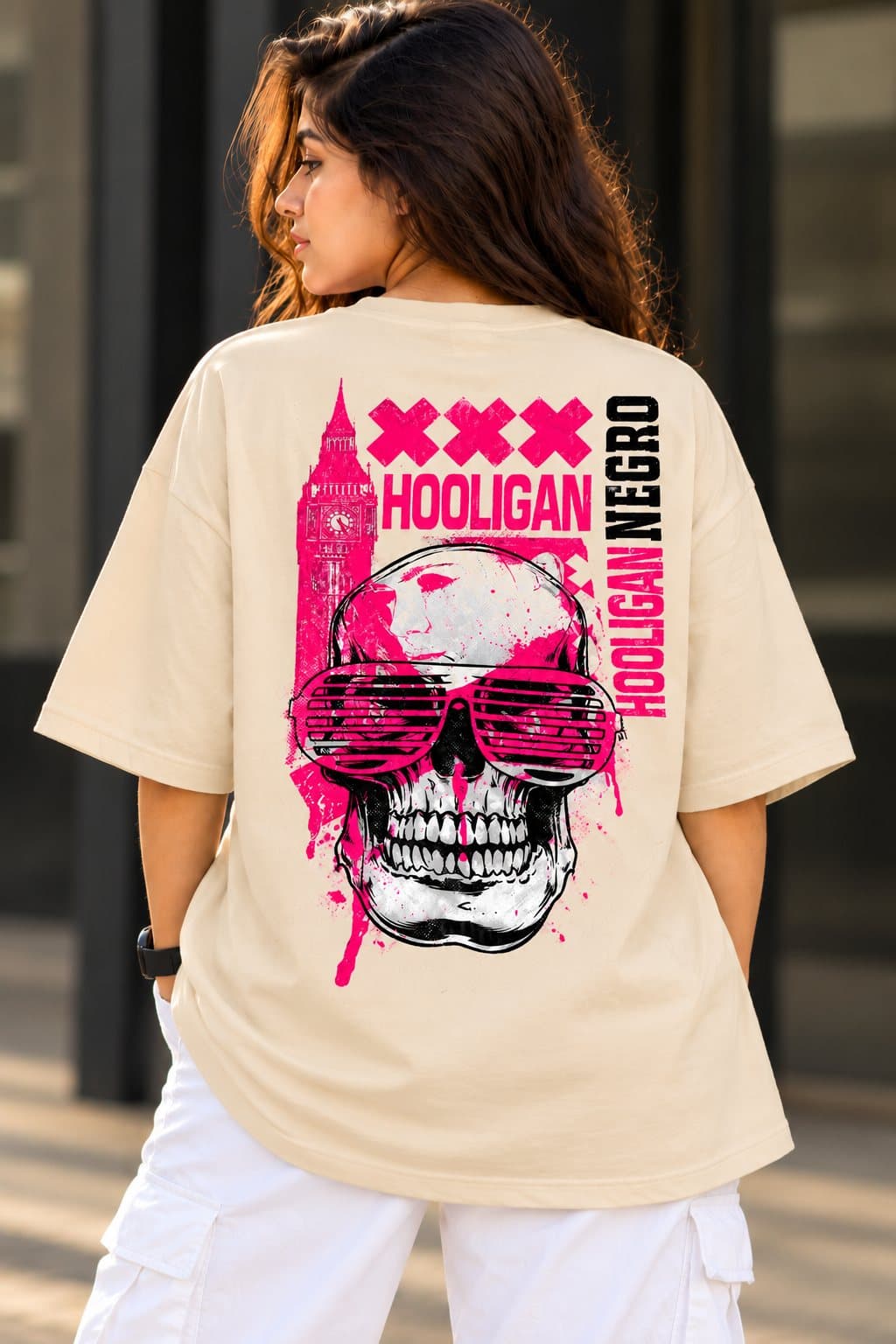
Want to see the detail? Our back-print tees are where DTF really shows off.
Keep reading
- How to Style an Oversized T-Shirt: 10 Easy Looks for WomenTen easy ways to wear an oversized t-shirt — with jeans, cargos, shorts, skirts and even as a dress — plus how to pick the right size.
- How to Wear an Oversized T-Shirt: A Simple Guide for MenHow an oversized t-shirt should fit, what to pair it with — jeans, cargos, shorts, layers — and the shoes that make it look right.
- Oversized vs Regular Fit: How to Pick Your T-Shirt SizeThe difference between oversized and regular-fit t-shirts, how to measure yourself, our size charts, and what to do when you're between sizes.